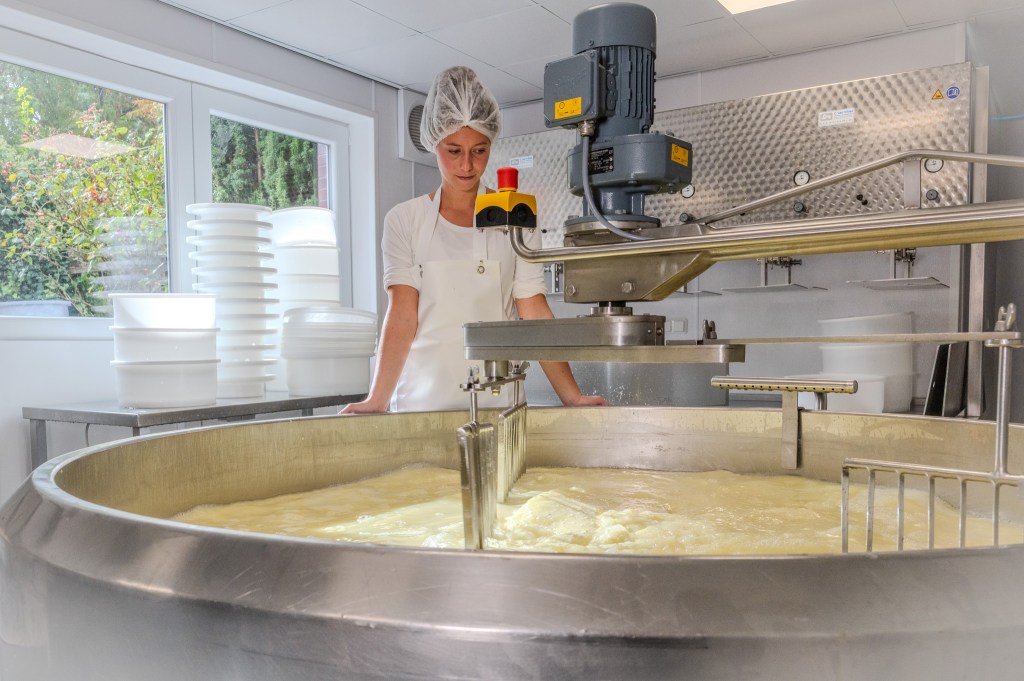
Gouda is a semi-hard cheese made from cow’s milk. Its character is decided in the first hours of production: how the milk is pasteurised, how the curd is made and how it is pressed.
This page gives an overview of those three steps as they are practised in the Netherlands. Each step has its own page with more detail about what happens, why it matters for the cheese, and which equipment is used.
From milk to Gouda wheel
- Pasteurisation: heating the milk, holding it at temperature and cooling it to the renneting temperature.
- Curd making: adding culture and rennet, cutting, stirring and washing the curd in the cheese vat.
- Pressing: pre-pressing under whey, filling the moulds and pressing the cheese.
After pressing, the young cheese is salted in brine and left to ripen for weeks or months.
Key numbers
| Typical value | |
|---|---|
| Milk needed per kg of cheese | about 2.6 Gallons (10 litres) |
| Pasteurisation | about 72 °C for 15–20 seconds |
| Renneting temperature | about 30–32 °C |
| Time in the cheese vat | about 1.5–2 hours |
| Pressing time | about 1–2 hours |
Values are indicative. Every dairy fine-tunes its recipe to its milk, its cultures and the cheese it wants to make.
What makes Gouda different?
Two things set Gouda apart from many other cheeses. First, the curd is washed: part of the whey is drained off and replaced with warm water. This removes lactose, so the cheese becomes less acidic and develops its sweet, supple character. Second, the curd is pre-pressed under the whey, which keeps air out and gives Gouda its closed texture with only a few small, round eyes.
Planning a Gouda cheese dairy?
Tell us about your milk volume, cheese formats and plans. We will come back to you with a proposal for the equipment that fits your dairy.